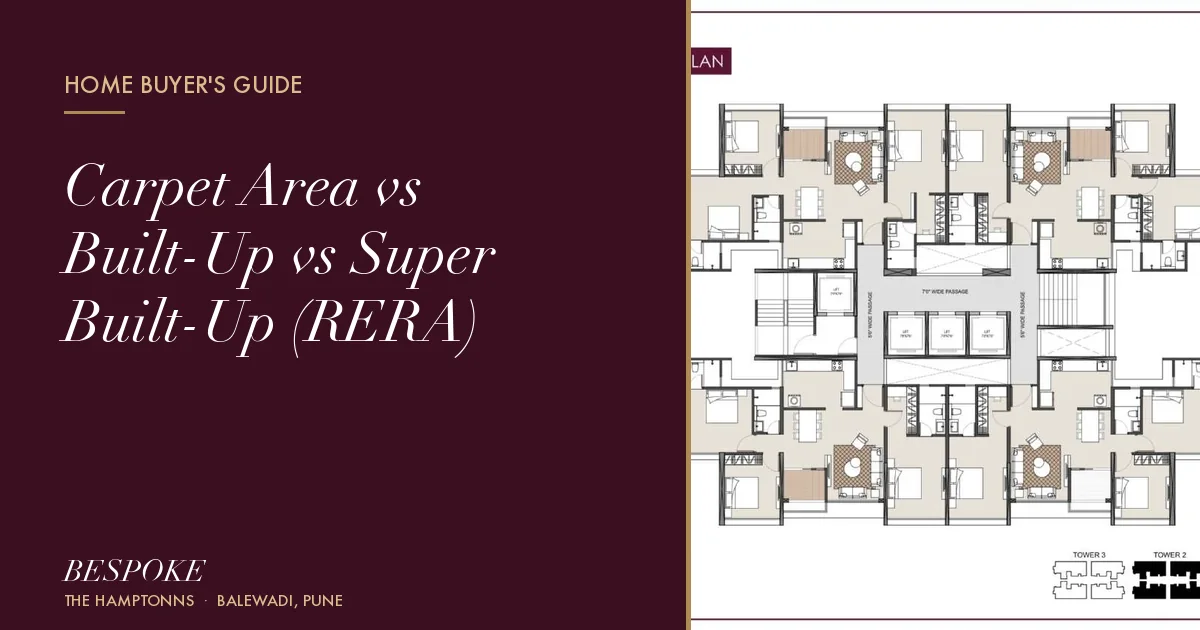
Carpet area vs built up area is the difference between the floor you can use and the bigger numbers often used to market a flat. Carpet area is the usable floor inside a flat’s external walls, built-up area adds those walls and usually the balconies, and super built-up area adds a share of lobbies, lifts, staircases and amenities. The RERA Act defines only carpet area, and in Pune the gap between super built-up and carpet, called loading, averaged 40% in Q1 2025 according to ANAROCK, so a flat marketed at about 1,700 sq ft may have only about 1,212 sq ft of carpet.
Key takeaways
- Under Section 2(k) of the RERA Act, carpet area is the net usable floor area, including internal partition walls but excluding external walls, service shafts, exclusive balconies or verandahs and exclusive open terraces.
- Built-up and super built-up area are not defined in the Act, so developers and brokers calculate them differently.
- Pune’s average loading rose from 32% in 2019 to 40% in Q1 2025 (ANAROCK).
- To turn a super built-up rate into a carpet rate, multiply by (1 + loading): ₹15,300 at 40% loading is ₹21,420 per carpet sq ft.
- The MahaRERA model agreement has the developer confirm the final carpet area after the occupancy certificate, with a 3% variation cap.
Carpet area vs built-up area vs super built-up area
We use a 3 BHK with 1,212 sq ft of carpet, the size listed for the Series 01 layout at Bhansali Hamptonns Balewadi, as the worked example in this guide. The conversions work the same way for any flat in Pune.
| Measure | What it includes | Defined in the RERA Act? | 1,212 sq ft carpet flat |
|---|---|---|---|
| Carpet area | Floor inside the external walls, including internal partition walls | Yes, Section 2(k) | 1,212 sq ft |
| Exclusive balcony, verandah, open terrace | Outdoor areas for the flat’s exclusive use | Explained in Section 2(k); disclosed separately | As per the plan |
| Built-up area | Carpet area plus external walls and, usually, balconies | No | About 1,372 sq ft (illustrative) |
| Super built-up area | Built-up area plus a share of common areas | No | About 1,600 sq ft at 32% loading, 1,697 sq ft at 40% |
What Section 2(k) of the RERA Act says
The Real Estate (Regulation and Development) Act, 2016 defines carpet area as “the net usable floor area of an apartment, excluding the area covered by the external walls, areas under services shafts, exclusive balcony or verandah area and exclusive open terrace area, but includes the area covered by the internal partition walls of the apartment.” In practice:
- Counted: rooms, kitchen, toilets and internal passages inside the external walls, plus the internal partition walls between them.
- Not counted: external walls, service shafts, and balconies, verandahs and open terraces meant for your exclusive use.
- Not yours at all: lobbies, staircases, lift wells and common terraces, which belong to the common areas.
The Explanation to the clause treats a balcony or terrace as “exclusive” when it adjoins the flat and is meant for the buyer’s exclusive use. Section 4(2)(h) requires the developer, when registering a project, to disclose the number, type and carpet area of flats along with these exclusive balcony, verandah and terrace areas. Those declared figures are on MahaRERA, as our guide on how to check MahaRERA registration explains. Because carpet area includes internal walls, the floor you can actually tile or furnish is slightly smaller.
Built-up area: the figure with no fixed definition
Built-up area is a market term, not a legal one. It usually means carpet area plus the thickness of the external walls plus exclusive balconies, and some calculations also add shafts, dry balconies or flower beds. In our example, if the balconies add 90 sq ft and the external walls 70 sq ft, built-up area is about 1,372 sq ft. Those two add-ons are illustrations, not figures for any real flat. Because there is no standard, ask the developer or broker for a written breakup whenever a built-up figure is quoted, especially on resale listings.
Super built-up area and loading in Pune
Super built-up area adds your proportionate share of common areas, such as lobbies, staircases, lift wells, the clubhouse and other amenities. Loading is the difference between super built-up and carpet area, expressed as a share of carpet: ANAROCK’s example is a flat with 1,300 sq ft super built-up and 1,000 sq ft carpet, which has 30% loading. Its 2025 study, reported by PTI, found loading rising in all of India’s top seven cities:
| City | Average loading, 2019 | Average loading, Q1 2025 |
|---|---|---|
| Pune | 32% | 40% |
| Mumbai Metropolitan Region | 33% | 43% |
| Bengaluru | 30% | 41% |
| Delhi-NCR | 31% | 41% |
| Kolkata | 30% | 39% |
| Hyderabad | 30% | 38% |
| Chennai | 30% | 36% |
| Top 7 cities | 31% | 40% |
Higher loading is not automatically bad: a clubhouse, wide lobbies and podium amenities take space. But you pay for that space in the price, and possibly in maintenance if the society bills per sq ft. At The Hamptonns, for instance, the amenities include a podium pool, clubhouse and roof terraces; ask any developer which common areas sit in its loading.
Considering a 3 or 4 BHK in Balewadi?
Bhansali Bespoke – The Hamptonns offers 3 BHK (1,186–1,212 sq ft) and 4 BHK (1,802–1,810 sq ft) homes in Laxmi Nagar, near Balewadi High Street. MahaRERA PM1260002600725.
Converting portal rates to a carpet rate
Two formulas cover most cases:
- Carpet rate = super built-up rate × (1 + loading).
- Super built-up rate = carpet rate ÷ (1 + loading).
At 40% loading, ₹15,300 per sq ft super built-up equals ₹21,420 per sq ft of carpet; at 32% it equals ₹20,196. The basis matters because portals often do not state it. Square Yards shows a Balewadi average of ₹15,300 per sq ft without saying whether it is carpet or super built-up. Applied to 1,212 sq ft of carpet, that rate gives ₹1.85 crore; applied to the 1,697 sq ft super built-up equivalent at 40% loading, it gives ₹2.60 crore, a ₹74 lakh difference for the same flat. Strip GST and stamp duty out of “all-inclusive” prices before you divide; our Balewadi property rates guide shows how.
Worked example: a 1,212 sq ft carpet 3 BHK
| Measure | Square feet | Square metres |
|---|---|---|
| Carpet area (RERA) | 1,212 | 112.6 |
| Built-up area (illustrative: +90 balconies, +70 walls) | 1,372 | 127.5 |
| Super built-up at 32% loading (Pune, 2019) | 1,600 | 148.6 |
| Super built-up at 40% loading (Pune, Q1 2025) | 1,697 | 157.6 |
One square metre is 10.7639 sq ft. Agreements and MahaRERA records often show square metres, so a 4 BHK of 1,810 sq ft carpet will appear as about 168.2 sq m.
Comparing two flats quoted differently
Flat A is advertised as “1,650 sq ft” for ₹2.05 crore, which looks like ₹12,424 per sq ft. Its agreement shows 1,150 sq ft of carpet, so its loading is 43.5% and its carpet rate is ₹17,826. Flat B is quoted on carpet: 1,212 sq ft for ₹2.15 crore, or ₹17,739 per sq ft. Flat B costs ₹10 lakh more but gives 62 sq ft more usable space and is ₹87 cheaper per sq ft of carpet. On a super built-up basis at 40% loading it would have been advertised at about ₹12,671 per sq ft, which shows how headline rates hide the real comparison.
What your agreement and possession should confirm
- The agreement states the carpet area as defined in the RERA Act, with exclusive balcony, verandah and terrace areas listed separately.
- The price is tied to that carpet area. Under the MahaRERA model agreement, the developer confirms the final carpet area after the occupancy certificate, subject to a 3% variation cap; a reduction is refunded within 45 days with interest, and an increase is billed at the next payment milestone (Free Press Journal, June 2026).
- The carpet area in your agreement matches what the developer declared on MahaRERA.
- At possession, an architect or surveyor measures the flat before you sign the possession letter.
Check figures yourself, because sources differ even on carpet area. The brochure lists The Hamptonns’ 3 BHKs at 1,186–1,212 sq ft and 4 BHKs at 1,802–1,810 sq ft, while the Square Yards project page shows 1,106 sq ft and 1,634 sq ft, both labelled carpet. One possible explanation is that one set includes balconies; we have not confirmed which. The MahaRERA declaration settles it. Compare layouts on our floor plans page, prices on the price page, and what the extra area buys in our 3 BHK vs 4 BHK comparison.
Bottom line
Compare flats only on rupees per sq ft of RERA carpet area. When a rate is quoted on built-up or super built-up area, ask for the carpet figure and loading in writing and multiply out, as our framework for comparing new projects in Balewadi does; at Pune’s 40% average loading, the same flat can look 29% cheaper per sq ft on a super built-up basis. This is general information, not legal advice; have an advocate check the area clauses in your agreement. If you want help reading a cost sheet, contact us.
FAQs
What is the difference between carpet area and built-up area?
Carpet area is the usable floor inside a flat’s external walls, including internal partition walls, as defined in Section 2(k) of the RERA Act. Built-up area usually adds the external walls and exclusive balconies, and sometimes shafts or flower beds. Built-up area has no legal definition, so ask for a written breakup. On our 1,212 sq ft carpet example it could be about 1,372 sq ft.
Is the balcony included in carpet area under RERA?
No. Section 2(k) of the RERA Act excludes exclusive balcony or verandah areas and exclusive open terraces from carpet area. Developers must disclose these areas separately when registering a project, under Section 4(2)(h), and they should be listed separately in your agreement. A balcony is still part of your flat; it is simply not counted in the carpet figure.
How do I convert super built-up area to carpet area?
Divide the super built-up area by one plus the loading. At 40% loading, 1,700 sq ft super built-up is about 1,214 sq ft of carpet. For rates, do the reverse: multiply a super built-up rate by one plus the loading, so ₹15,300 per sq ft becomes ₹21,420 per carpet sq ft. Ask the developer for the actual loading rather than assuming an average.
What is a normal loading percentage in Pune?
ANAROCK found Pune’s average loading rose from 32% in 2019 to 40% in Q1 2025, against 40% across the top seven cities and 43% in the Mumbai region. Loading is the gap between super built-up and carpet area as a share of carpet. More common area, such as a large clubhouse or podium amenities, means more loading, so judge it together with what those areas offer.
Can a developer sell a flat on super built-up area after RERA?
The RERA Act does not use the term super built-up area. Projects must disclose carpet area at registration, and the MahaRERA model agreement ties the price to carpet area, adjusting it if the final carpet area changes. Marketing material may still quote larger figures. Rely on the carpet area in the registered agreement and on MahaRERA, and ask for the price per sq ft of carpet.